Free time done right
A 2025 look-back and some advice for intentional fun

This isn’t a numbered list. It started that way, but I changed my mind about how to format my wrap-up diary. Realized that I had now clue of how to undo Substack’s insistent CMS, which plunked a 10 at the upper left and will not let it go. So I’m going to plow ahead and use a kludge to drop the list format. Word processors are forever seeing numbers and “helping” by tossing everything into bullet points, and given that people intentionally use LLMs to help them list-ify tasks, I expect to just deal with the irritation.
I’m a stubborn person. I make decisions quickly, then ignore noise and plug away at whatever I decided to do. This is annoying trait for other people to live with; I’m constantly pointing myself in a direction, walking towards it, and a few minutes later, noticing that I didn’t hear the people or person who had another question about what I’m doing and didn’t start walking. And I’m completely uninterested in getting this behavior diagnosed. It’s who I am; I plow ahead until I find some text or piece of music that distracts me, and then, I get lost in it. Plus: I recognize this behavior in every curious boy, who wanders off in search of whatever just made that interesting sound, as his parents panic, and set off in that arm-swinging half-run that makes you look goofy but not terrified.
Some of my abandoned posts from last year were guides to my hobbies, for anyone else who might want something new to read. First, I’ll explain how I spend my seated downtime (distinguished from much healthier and more boring upright downtime), and pick out a few things I’d recommend to anyone.
Some advice — which is how I wandered into that whole numbered-list trap.
Go beyond the IP shelf. A quarter-century ago, the popularity of Peter Jackson’s “Lords of the Rings” movies and Sony’s schticky Marvel Universe movies sped up a rush to adapt certain kinds of “nerd” material into films. The sci-fi and comics-reading audience consumed more media than other audiences. Most adults would buy a few books a year and see movies with family. The obsessive fan would buy these books as soon as he opened each paycheck.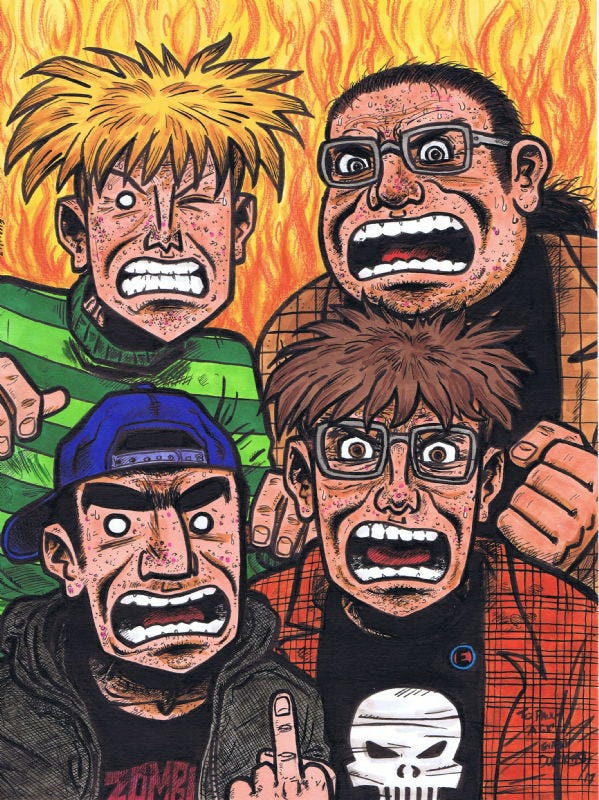
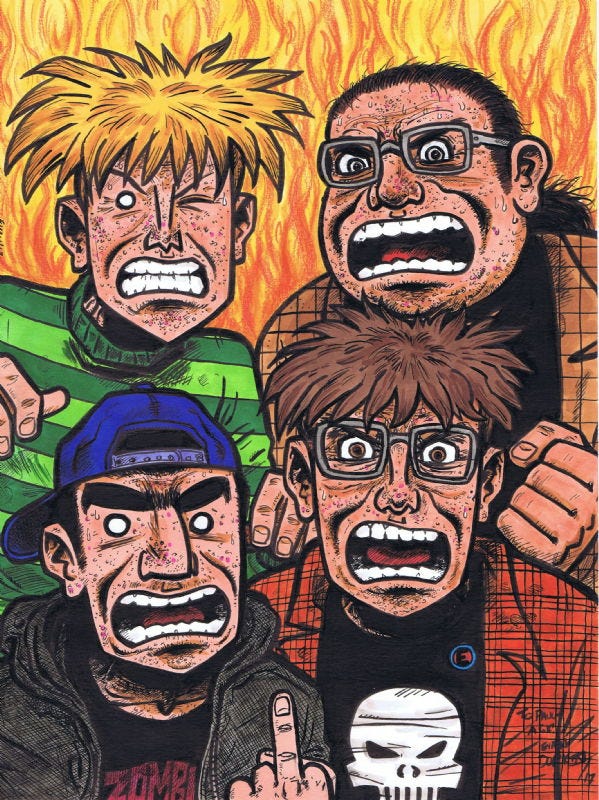
(Evan Dorkin’s “Eltingville Club,” still my favorite depiction of the obsessive nerd in the age of plenty)
This meant that fiction that was adaptable into an exciting movie or a TV series — clear hero’s journeys, big characters, existing fanbase — often got adapted. I watched those movies, when I cared more about pop culture, and they were fun to talk about with friends. But all genre is limiting. In Big Fiction, Dan Sinykin’s history of publishing’s “conglomerate era,” you learn that the professionalization of the industry meant better research on what sold, which means what sold was most of what got published. The Program Era gets more specific about this. Tolkein, in particular, has inspired waves of fantasy writers who follow his steps. These are entertaining books, but that’s all they are. Not challenging, not capable of making you uncomfortable. You visit a book store, scan the front shelves, and the covers — medieval fonts on the “romantasy,” bright colors on the slice-of-life books — blur together.
I tried to resist this slide to comfort, by reading older books. When I did read genre fiction, it was from periods where the standards were different, and readers had fewer pre-determined expectations. That got me to The Opener of the Way, a 1945 short story collection by Robert Bloch published by Arkham House, the outpost for cosmic horror that kept that genre alive when it was unfashionable. I finished The Lathe of Heaven, Ursula K. LeGuin’s fantasy about a man whose thoughts can change reality. Possibly adaptable, and maybe someone’s tried to, but on paper it’s to weird to work — which is why it works, in disorienting prose, just like J.G. Ballard’s The Crystal World. They’re unsettling books and wouldn’t be worth reading if they weren’t. The pulpiest thing I’d read, polishing it off after putting it down years ago, was Marching Through Georgia, the first in S.M. Stirling’s series of novels about a South Africa-based racist empire that eventually conquers the earth. Not adaptable, but more than it would have been a few years ago.
Read short stories. I’m half-finished, or less, on about a dozen collections of short stories. They aren’t made for long marathon reads, and most weren’t published that way. And I picked good ones, skimming advice from the velvet-voiced YouTuber “The Library Ladder,” a semi-anonymous man (“Bridger”) with complete knowledge of weird fiction.
That was how I found Bloch, and he put me onto Tales of the Cthulu Mythos, the 1969 Arkham House collection that gave a kind of blessing to cosmic horror with non-Lovecraft writers. Lovecraft had opened his fictional universe, with gods that traveled from other worlds to be worshipped on Earth, during his lifetime. Conan creator Robert E. Howard wrote a story in it; Frank Belknap Long and Clark Aishton Smith achieved longevity by throwing in more.
The year ended with seven bookmarks planted in short story collections that I won’t finish for a while, or ever. The best of them was Her Smoke Rose Up Forever, the best collection of James Tiptree, Jr.’s science fiction stories; it’s wandered in and out of print, but Gollancz publishes a handsome version as part of its SF Masterworks series. “The Screwfly Solution” is the story I recommend starting with, containing not just the twist that every good magazine sci-fi story needs, but a killer, unique premise: All over the world, men’s sex drives are replaced by a violent urge, and they begin killing women instead of starting families with them.Embrace the cornucopia. No technological breakthrough has saved me more money, personally, than the one artists hate: Streaming music libraries. In the CD era, I was a sort of crate-digger, getting interested in a band or artist and buying everything they made, cheap. That wasn’t always possible. In my power pop phases, early in college and then right after, I bought out-of-print anthologies and a double LP by The Toms, a band with only one song I truly loved. Lots of spending with low upsides. Every few months I’d find a favorite song that no one else listened to anymore, but I stacked a lot of weak albums that took up space under my bed.
Despite that, I think feeling real guilt about the unfair royalties system, I didn’t begin using Spotify until 2018 and Apple Classical until this year. This obliterated my old way of collecting music, and even organizing it in my head. I could now hear about a song and listen to it within seconds. In Meet Me in the Bathroom, Lizzy Goodman’s oral history of the 2000s New York rock and dance scenes, James Murphy mourns for how this technology — really just the ability to trade music online — hit obscurantist DJ culture like an asteroid. His art was now a hobby for dilettantes.
That’s true! That’s where I showed up. I decided to listen either to new-to-me music or to do something interesting with my old favorites, like organizing them into playlists. This year I did much more of the former, focusing on jazz and orchestral music because I wanted more calming, challenging music to play when the baby was listening.
Murphy in my head, I see this as a silly hobby. But I see fairly few people listening to music like this, seeking it out, even when they’ve subscribed to a streaming service. Quite a lot of people just ask for music that sounds like what they like already, and have not noticed when that music is AI-generated. When informed, a lot of them don’t even care.That filled me with purpose, to figure out a better curate-everything strategy. There was more previously-recorded music, by people, than anyone would be able to hear in one lifetime. Why even start with the fake stuff? Because it’s easier, and I keep finding out how popular it is to skim entertainment and not think much about where it comes from.
I don’t judge that attitude at all. Researching music and getting the metatext for what you’re listening to is a hobby, one that doesn’t teach a skill (except memorization) or create an object (except playlists). But it’s intentional; it pays attention to the artist. And I have more fun doing it.
Andrew Hickey’s “The History of Rock Music in 500 Songs” podcast covered The Yardbirds, through an episode on “Train Kept a-Rollin’,” and reminded me that Graham Gouldman had been a hot songwriter for hire long before he formed 10cc. On Spotify, Pete Trallhatten had put together hours of Gouldman’s songs, and I played through it, finding some strong pop hits that were being forgotten as the capsule history of 60s British music becomes more and more about the Beatles.Before my wife and I went to Italy, I checked what had topped the Italian pop charts since the start of the rock era, through 1980; my wife had Italo-Disco, which really picked up after that year, totally figured out.
This gets to another piece of advice: Go back in time. The old style of taste-making, the one that could sustain a lifelong career in criticism, keeps fading away, but it was never infallible. The most popular, most-awarded culture of a given year usually includes some of the best, but not all of it; retrospective reviews “discover” some books and music that didn’t sell, and it lives larger than the books and music that did.
So I’d read contemporary critics like Whitney Balliett or Robert Christgau, and listen to what they elevated, and I’d read histories that revealed what most people were actually listening to. In 20 years, I doubt many people will want to re-hear The Life of a Showgirl, Taylor Swift’s clumsy and narcissistic 2025 album, and more will listen to “Love Takes Miles,” the strongest song from rising star Cameron Winter’s album. But you’ll have to hear “The Fate of Ophelia” to recreate what the 2025 mood was. I did some trimming of my year-by-year pop playlists, which are based first on the year-by-year charts in the U.S. and U.K., then altered to include good songs from those years that the public didn’t discover — or, very often, were kept off the segregated lists stores used to track hit records.This attitude has helped me discover dozens of songs that either didn’t get into my mainstream media diet or weren’t in any American’s rotation when they came out.
I also looked for more ambient music that could play while I was working, or reading, and could help put a baby to sleep. This got me over to Morton Feldman, the minimalist composer who was part of John Cage’s set but, after his too-early death from pancreatic cancer, became less famous. Feldman’s music is much more appealing, to my ears: Melodic and slow, sometimes drawn out for hours, testing the endurance of the musicians who have to play it.
Listen to soundtracks. Thinking about how to spend my downtime — is any movie more worth two hours than a truly great book — I usually defend my decisions with Wagner. He saw opera as the “seeming point of reunion of all the three related arts” — poetry, music, dance. The challenge of writing a soundtrack, of getting prompts or watching silent pieces of film or convincing a filmmaker that you can improve on his dummy track, produces some worthwhile music that would not exist without the film, but can breathe loud outside of it.
Read old books. Years ago I was invited to a dinner with then-Sen. Ben Sasse of Nebraska, who was very giving of his time and insights, even as one member of the party (not me) fell asleep during the post-dinner coffee. He was already bored by arguing with the president, who could waste his entire week by posting some insult on Twitter. When he talked about reading — specifically, what he gave his kids to read — he lit up. One of his guidelines, for them and for us, was not to read anything published within the last 50 years, because it was too soon to know whether it had lasting value.
One guy’s opinion, but I mostly agree with it now. I read around 150 books last year, not counting graphic novels, not counting art books, not counting audio books, which some people don’t count at all.
The legit reads fit into three categories: Books from the Western Canon, nonfiction that covered some topic I didn’t know enough about, and fiction with some kind of vetting — word of mouth, awards, so on. Harold Bloom’s guide to the canon was, he claimed, tossed off, and no list like that can exit without getting argued about. Another, sillier, but helpful guide: If I have seen a book referenced or parodied in a headline, I might check it out.
This I call the Raymond Carver rule, because I frequently see the title of his short story “What We Talk About When We Talk About Love” interpolated into headlines. Puck (I’m a subscriber) does this all the time; a headline that didn’t really make sense, apart from its reference to an award-winning novel, was “All the Oversight We Cannot See.” There is something cargo cult-ish about borrowing the pleasing wordplay from an old story, but not reading the story. So I’ll eventually read the stories.
Reading more intentionally, last year, did not solve all my problems. But it kept me separated from the gushers of moronic, easy-pleasing content that are, for many people, filling the time they used to fill with a book or a newspaper. Plenty of people have said what I think on this topic, particularly James Marriott.
There we go. Throat cleared. I read and listened to a lot last year. This year, as a father, I expect to read and listen to a bit less. But I’ll track it again, after I name some 2025 favorites and get back to the next bottle feeding.
Some major books I liked. Dante Alighieri, Inferno. Read the Allen Mandelbaum translation, which sticks to verse and, I’m informed, is less thrilling than the Anthony Esolen translation. It was thrilling enough for me, and helped by the Kindle format, which lets the reader check which disreputable but forgotten Italian Dante’s talking about. I’d seen so many pieces of this interpreted in cruder pop culture — Bill and Ted in Hell, Jack (in “The House Jack Built”) crossing the water over perpetually drowning men in Eugene Delacroix’s painting. So much of the horror genre’s source code was here. Not much weird fiction out-does the introduction of Satan:
The Emperor of the Universe of Pain jutted his upper chest above the ice;
and I am closer in size to the great mountain the Titans make around the central pit, than they to his arms.
Marcel Proust, Swann’s Way. The Lydia Davis translation, which I picked up on a 2013 trip — it was in the Museum of Jurassic Technology’s gift shop, not sure why — and couldn’t commit to until a few days off this spring. Give it some dedicated time and it flies. “The memory of a certain image is but regret for a certain moment, and houses, roads, avenues, are as fleeting, alas, as the years.”
Herman Melville, Moby-Dick. I’ve been friends with super-fans of the book, who won’t hear that another novel’s better; one had a section of it read at her wedding. Came prepared for the wonderful digressions into whale anatomy and the use of its body parts. Did not expect how gripping the final chase would be.
Paul Fussell, The Great War and Modern Memory. I read his less well-regarded World War II study (Warfare), and recommend both of them — truly useful cultural history of how people at the front and at home actually experienced war and why they made the art they made about it. Reading this pointed me to Anthony Burgess’s The Wanting Seed, another easy recommendation; in its overpopulated, suicidal future, the state gives some men a trench warfare simulacrum to kill them off.
Kazuo Ishiguro, The Remains of the Day. Gave me new appreciation for the Merchant Ivory adaptation, which jumbles the narrative and, thanks to Anthony Hopkins’s talent, conveys the self-negating philosophy of Mr. Stevens.
Leo Tolstoy, Hadji Murat. Started to fill the embarrassing, Tolstoy-shaped gap in my reading with this novella. The Nicholas II digression is controversial; the haters are wrong about it.
Some histories I liked. A. Scott Berg, Max Perkins: Editor of Genius. An award-winner at the time, kicking of Berg’s career as a biographer of men whose reputations had been weakened by more-popular critics, this was even adopted into a movie nobody saw: “Genius,” with Colin Firth as Perkins. You see why it felt adaptable; Berg gets to tell the origins of Fitzgerald, Hemingway, and Wolfe, through the zippy story of an intellectual with endless patience, thriving in an unrecognizably literary country.
Benjamin Netanyahu, Bibi: My Story. American political memoirs, by people still interested in winning elections, are usually formulaic, honeycombed with false, voter-pleasing humility. This is the first Israeli political memoir I’ve read, and it’s completely unapologetic, with Netanyahu congratulating himself for outwitting American politicians, and settling scores with Israeli politicians (a digression into how phony Ehud Barak’s war record is, according to Bibi). Very useful stuff about how he would rely on Joe Biden’s eagerness to support Israel to undermine Barack Obama.
Peter Biskind, My Lunches with Orson. The first half of this, including Henry Jaglom’s introduction, is a some of the funniest gossip I’ve ever read — an account of the first year when Orson Welles would take Jaglom to lunch and vent his spleen. The second half flags because Welles was flagging, getting tired as he crawled toward death.
Michael Grynbaum, Empire of the Elite. A history of Conde Nast’s 80s-00s heyday that reads as, and is designed to be, a eulogy for a dead industry. As many fun anecdotes as you’d expect, nestled next to some solid reporting about how the elite media worked, when I stareted reading it, and when nobody warned me not to enter it.
S.T. Joshi, Unutterable Horror. It starts with the Epic of Gilgamesh and ends with the author ranting about Joe Hill’s worthiness to write weird fiction. That’s fine; it’s not an academic book, it’s the history of horror by a man who has consumed more of it than anybody else on the planet. God bless Joshi. (He’d hate that I said that.)
Best Cookbook. Just one: Eric Wareheim’s Steak House, a combination travel guide (great and old steak houses in the United States and Mexico) and recipe book. Wareheim built a comfortable lifestyle with his surreal comedy series (plural) and directing work; he now owns a vineyard and hosts beefsteak dinners for friends. Beautiful verité, achievable recipes, solid throughout.
All right: Back on the Sunday newsletter horse. I have a lot to finish in January, but aim to pick this up every weekend.
There was a good power pop compilation released by Cherry Red this year named after The Toms song, I Wanna Be A Teen Again: https://open.spotify.com/playlist/5EZOkGVKfyVVmCMMfoQe2u?si=0c208b1d36da4901
Some gems in there!
I have been a hard-core music fan since I was in high school, buying random cutout albums because that was the only thing I could afford. But back then, I promised myself I wouldn't be one of those people still listening to the same music at 40 that they were listening to in high school.
For all the problems with streaming, I also appreciate being able to find new things without having to buy endless albums I'll never listen to again.
My playlists tend to fall into a couple of buckets: stuff I listen to when I write and stuff I listen to as background music or when I want to just enjoy the music. The former includes playlists such as the best of Elvis' movie tracks, random great pop songs no one remembers or 90s pop/rock tracks. The latter playlists are things like a playlist of Northern Soul songs or this playlist called "The Coolest Jukebox In Your Favorite Southern Dive Bar"
https://open.spotify.com/playlist/5NxwyidJRiYn9cI2MhQAmn?si=da8f5a2156a04606