The great indoors
Week three, let's keep it going

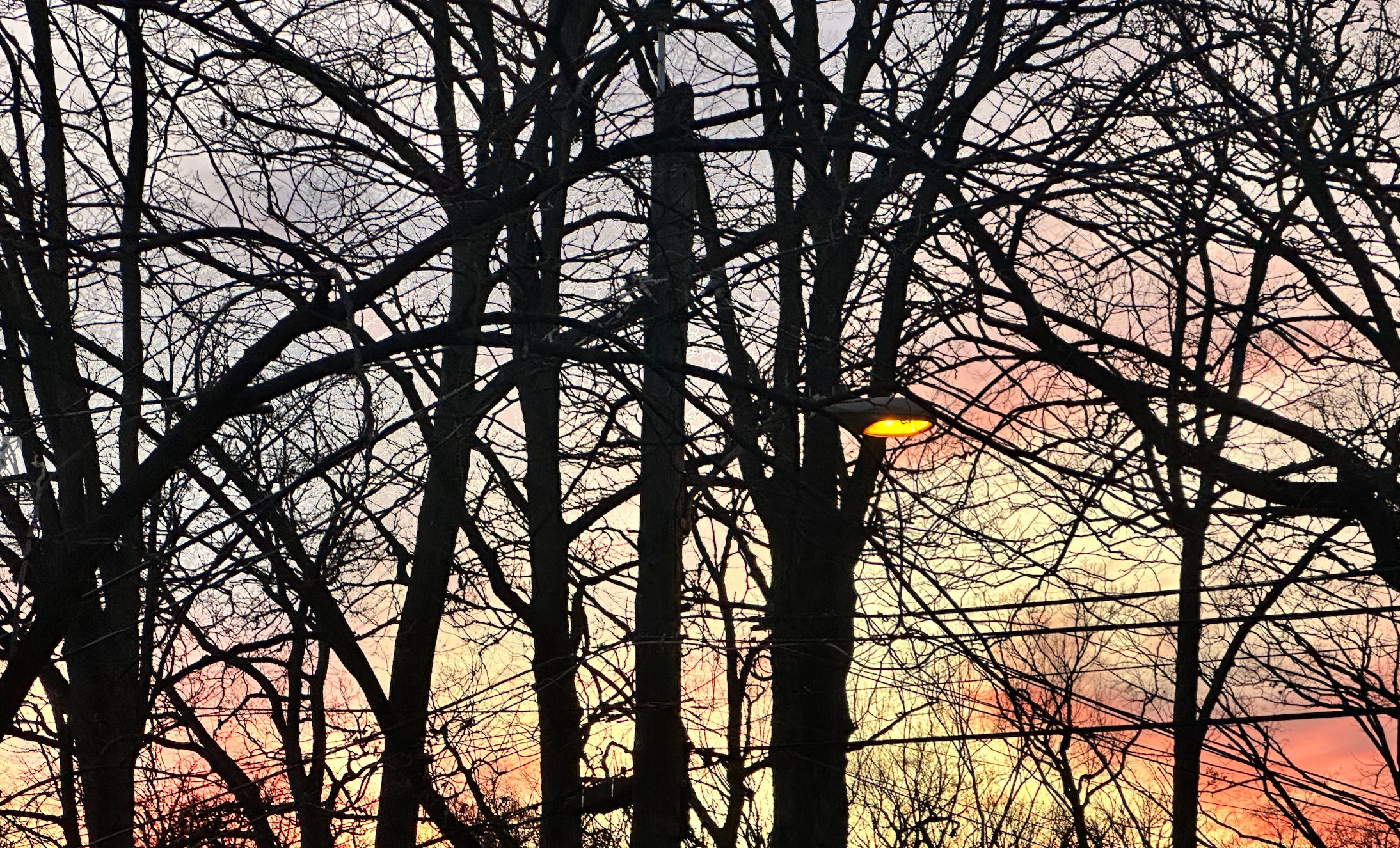
(Photo of some bare trees in our city, taken by me)
My major non-family goal this month is finishing a 30,000 word manuscript. The mini-goal, this week, was writing or buffing at least 15,000 words of it. I pulled that off, and don’t sweat that job on Sundays, so voila, more newsletter.
The newspaper life makes it much easier to do this sort of work with a kid in the house. On a typical day, in the thick of campaign season, I might have to write a 1200-word piece in two hours, interrupted by calls, moving from one location (like an event space that’s closing) to another (a cafe that’s closing), switching wifi networks, maybe just saying “screw it,” pushing the car seat back, and filing from there. Great practice for writing a paragraph and then jumping up to re-place a pacifier or grab a Dr. Brown’s bottle of milk. I know people who’ve finished major projects by isolating themselves for the final month — renting a cabin in rural Colorado, booking a cabin on a ship that’ll take weeks to cross the Pacific and Indian Oceans.
Well, not me. And by no means am I putting a halo on or advising you how to write big projects. But if you spent long enough piling up sources and organizing them in nested folders, you, too, can write tens of thousands of words in between baby duties.
That’s all I’ve got right now — writing, fatherhood, a walk outside if it’s nice enough, a walk with the stroller if it’s even nicer. Movies are off the schedule for now, and I’ve watched only what my wife’s put on. The big show on Saturday was “One Battle After Another,” which she hadn’t seen, and I’d been a sucker for, long before it could be contested by the critics who weren’t impressed and the casual viewers who hated it.
Taste is subjective, but let’s be serious. The people who think this movie is terrible have mostly swung at it for ideological reasons (the French 75 don’t win, but Paul Thomas Anderson is sympathetic to them, which is bad), or baby-brain reasons (the characters make stupid decisions, not the smart decisions I would make on the run from the fascist police state). The latter take, much more irritating. I didn’t think the “Marty Supreme” discourse — grown men arguing that the snotty main character should have gotten a comeuppance — would be surpassed so quickly.
The gripes all flow toward the same basic idea, that the movies make the viewer uncomfortable. I’m being a little ungenerous, but not very. The “Marty” skeptics left the theater unhappy that they’d watched a hothead who gambles away many chances at his dream get unexpected fulfillment. The “Battle” skeptics, at least the ones I’ve seen, bristle at how stupid the movie’s deep state society (The Christmas Adventurers Club) is or how ridiculous Junglepussy sounds when she gives a Black Power speech walking across bank teller tables. It would be lazy to sit back and critique none of a movie-maker’s decisions, but I don’t see many haters and punk trash who try to understand those decisions.
My honed YouTube recommendations, the fruit of many “do not recommend” clicks on listicle and AI crud, showed me a relevant video essay this week. I’m not ready to endorse every Hilary Layne take; I’m more open to them than the people who clock her as a cultural conservative (she sure says '“the current year” a lot) and refuse to watch her. But I would recommend her videos on the pornification of book publishing and “why we never got another Lord of the Rings.” The answer, in the second video, starts with the commodification of a formulaic sword-and-sorcery story under Lester Del Ray; she continues it with an argument that the anti-Del Ray/anti-Tolkiens, led by Michael Moorcock, inverted the formula instead of innovating outside of it.
I was already inclined to agree with that, having spent the last two years reading pre-Del Ray fantasy and sci-fi stories and rejoicing in all the stories that can’t be easily turned into TV series. But I had not thought as hard about it as Layne. Why do I get a little bored by the Critical Drinker and his acolytes, when I basically agree with their assessment of mass-market sci-fi since 2016? He (and they) are too nostalgic for a certain kind of hero story — boy overcomes odds, overcomes setbacks, defeats evil.
Very good substack, too, and when I’ve pushed other work out of the way I aspire to work as hard as her on reading lists.
The Best Thing I Watched. We did enjoy one TV show more than we expected: “I Love LA.” Over a few nights we watched all eight episodes of Rachel Sennott’s Silverlake piss-take. It felt a little familiar at first; there is a b-plot about a quartet of earnest, handsome gay influencers who keep getting into ATV accidents that reminded me of The Instagays, the moronic social media stars in “The Other Two.”
But “I Love LA” is a little less silly than that show, which cranked up the parody of post-talent show-biz, retconning Jan. 6 into an op organized by a pop star’s manager in order to distract people from his awful album. Haven’t seen “Hacks,” but I don’t think has a joke about characters being relegated to the overflow room of a funeral because too many influencers shared the location of the main room, and I know its premise; Jean Smart’s baby boomer comic gives it a going-up/going-down dynamic, not present here. “I Love LA” is entirely about mid-level talent managers and celebrities, with a strong joke-per-minute rate. One that stopped me cold for a minute: The leads waking up and realizing that they got matching “The Nightmare Before Business” tattoos that will make the dress one stole for an invite-only dinner unwearable. Very strong parodies of the current, post-imperial moment east L.A. is living in, as the jobs for staff writers shrink but the checks still get cut for LGBTQ-friendly cracker ads.
The Best Thing I Read. Definitely “Emphyrio,” a Jack Vance novel I took on because 200 pages felt doable when I was interrupted every five minutes. And it was, but I’d recommend reading it in a few hours, in one go. Vance’s hero, growing up on a cucked planet where everything but artisan work is banned, investigates what happened to an ancient hero, and in so doing becomes the hero.
I kept one airpod in my ear to finish Jordan Peterson’s second book of advice for young people, “Beyond Order," read by the author, at what now looks like the peak of his fame and influence. I’m not saying that cheerfully. If liberals could drive the Delorean back to 2016, they would not be so glib and dismissive of young male alienation; you don’t have to be conservative to tell teenagers and twentysomethings to take care of themselves and read the great books. “Beyond Order” was published after Peterson became a phenomenon, and brought the swagger he earned from his psychiatric practice and academic work to, for example, the COVID vaccine. It won’t harm your teenager, but you can just give him Meditations — much quicker.
Books read
Jordan Peterson, “Beyond Order”
S.T. Joshi, “The Weird Tale”
Jack Vance, “Emphyrio”
I try not to think out loud about my day job on here, but I won’t be writing or speaking about politics for another month. This may be a good place to briefly list ideas. One small one: The Democratic Party’s recent problems, which are related to the reason Peterson became so successful, mostly date from the 18 months after the 2012 election, and the self-convincing by liberal pundits and organizers that Barack Obama “systematically provided” that Democrats didn’t need to worry so much about conservative white men. If you weren’t there (I was at Slate), this was a very common idea, and taste-makers — magazines still mattered back then — agreed that the arc of history only bent one way.
In December 2012, the Sandy Hook shooting convinced the re-elected president to re-open the gun control debate, which he’d avoided to win twice. In April 2013, you saw the Associated Press stop using the term “illegal immigrant” under pressure from Latino and Asian groups. In July 2013, George Zimmerman was acquitted in the Trayvon Martin murder trial and the #BlackLivesMatter hashtag went live. In May 2014, TIME announced the “transgender tipping point.” (“For the majority of people who are accustomed to understanding gender in fixed terms, the concept of a spectrum can be overwhelming.” True!) Many of the debates I still see among liberals boil down to this question: How do they get back to the optimism of this period?
Maybe I’ll have time to think about it. I wrote quite a lot about ostinatos today, so I’ll want a break from the fun stuff and a return to the real stuff soon. Back on Sunday.
Jack Vance! I have waited a long time to see a mention of any of his works. I found him when I was looking n college and his rich worlds, amazing vocabulary and subtle humor are all samples of science fiction at its best. Thanks for your reference to him.
Love the shoutout to Emphyrio - Jack Vance's worldbuilding in that one is so dense compared to alot of modern hard sci-fi that feels engineered for adaptation. The planet where only artisan work is allowed is such a weird premise but Vance totally makes it work. Been trying to get through more pre-formula sci-fi and its wild how much those stories trusted readers to figure stuff out instead of explaining everything.