Trapped Under Ice
Good Metallica song, not a huge problem for me this week


(Photo by me, last week)
The important stuff you’re looking for is over there. Kerry Howley was in Minneapolis last week, and my colleagues were in Davos. (“It’ll be worth holding big events at the WEF,” one of my favorite Semafor bets that paid off.) My week was comfortable, and I won’t brag about it. I said I’d finish a first draft of my side project, and I did, sending it off, beginning to enjoy the day in. (It’s a short book about the game Bloodborne from this great publisher.)
Everyone in our party of the country is in, unless they can’t concoct a reason to stay in, or they do useful work which puts them outside. Is any public servant greeted with more bliss than the plow-driver? Not the police officer, the fireman, or the soldier. I am doing an average of all interactions, and there are lots of negative encounters with those three, on average. Even the fireman; the person being saved from him might feel embarrassed about why he needs him, like it’s his fault. Imagine Charlie from “The Whale,” the little-loved (except by industry awards voters) adaptation of the play. He’s turned the middle of his life into the end of it by binge-eating himself into near-immobility. If he saw a fireman bust through his door, wouldn’t he feel terrible? Would he give a short, breathless speech about how everything in his life was a mistake except his daughter? Maybe. Something worse happens to him in the play/movie, but the point I’m trying to make is that some people, in some situations, don’t want to see these heroic public servants.
Not so with the plow-driver. It’s nobody’s fault we got snowed on last weekend, then sleeted on, creating a floor of ice with softer centers about an inch beneath. I whipped around with idiot delight when I heard one rolling by the night of the storm. Our driveway was navigable because I’d put on a flannel and my Patagonia jacket, which was already showing dirt from wear since October, and shoveled everything I could while the sleet came down. This gave us nearly-navigable driveways and walkways that became really navigable when some neighborhood kids offered to clean it. They wanted five bucks each. I promised five, and thought of upping it again when one said “it’s hard” — I realized, attacking this ice-concrete was fun for them. Young people pay a hundred bucks or so to smash things with hammers in the danger room of some ax-throwing places. This was free. I still should have upped the payment.
We are lucky, and were going to be at home with or without a storm. The kid wakes and eats often enough that it’s good for both parents to be with her, and I’m doing baby-related chores until they become natural to me, the sort of chores I’ll complete without thinking about them, like clearing the sink and putting everything in the dishwasher. (Ask 22-year old Dave if this is an “automatic” task for him.) It’s not terrible to walk outside if you’re suited up for it, but it’s terrible to walk while holding anything heavier than a dog leash handle. If we needed something — I had shopped poorly the prior week, and we needed rice and coffee — I preferred to get in the family SUV with four-wheel drive I’d paid for in anticipation of this kind of weather. It had the power to push over the ice mounds kicked up by the plows, between the street and sidewalk, and I joined five other shoppers at a re-opened grocery store. We nodded smugly at each other. At least, I nodded smugly at them, and hoped they understood why.
I haven’t been thinking much about day-to-day politics. I’ll re-share colleague’s pieces, and I’ll get annoyed at everyone on X falling for some old piece of media cut down to be shared out of context and make them angry. Example: Someone clipped one of the answers Boston Mayor Michelle Wu gave to an immigration question, the kind she frequently gets on GBH’s “Ask the Mayor” series from this:
Every person, every single human being, has the legal right to come to the United States and seek asylum or shelter, and those policies have been in place for a long time.
To this:
Every single human has the legal right to come to the United States.
You’re reading this, so you’re literate, and can distinguish what’s different in those two statements. The first statement is fairly standard liberal legalese, a table-setting statement about how immigration law works. The second is a statement of principle: That anyone, without conditions, has the right to come to the U.S. and presumably stick around. And one of the great stories in politics right now is how the Trump administration is using its powers to break apart the buffer zone that liberal immigration attorneys have built over decades. (Read JD Vance to Ross Douthat on this.)
One of the pretty good stories about the Democratic Party’s problems is that they everyone who thinks like Wu is in their party, and talk about post-1965 immigration norms as if it’s impossible to imagine disagreeing with them or changing them. A more boring story: Too many people react to clickbait without asking where the source is. To a fault, I’ve always wanted to chase down the full context of something before I write about or even react to it, because I hate being suckered.
Why don’t other people mind being suckered? I think they do. The first person to get a fact, or fact-shaped thing, in front of a person, benefits from protective cognition. The person learns X; he is told that X is incorrect, and Y is true; he gets annoyed and is inclined to defend why he thinks X is true. (See Dale Carnegie on this, and on why you should never correct somebody’s pronunciation if you want to sell him something.) I don’t like to be a know-it-all. Not any more, I don’t. I just don’t want to fall for bullshit. Did I mention that the Wu quote is from 2023 and that she’s reacting to Biden administration policy? What a waste of time. Why spike your cortisol for this?
But I spent very little time online, and mostly read material for book research; I’ll have a lot to recommend from that in another diary entry. Once I was done, I could polish off other reads.
The Best Thing I Read: Hermione Lee’s biography of Tom Stoppard, which I started in the hospital the day he died. I was running home to grab more supplies and bring them to the labor suite, and remembered; I’d grabbed a remaindered copy of Lee’s book at Vroman’s, then put it on a shelf and forgot about it. Into the go-bag it went. I read about 200 pages in the hospital, through to his late 60s success, and hacked away at it in December and January. I finished the final section, after Stoppard gets his Order of Merit and starts working on his “Parade’s End” adaptation, on Saturday morning, looking up sometimes to watch a rabbit navigate the ice shelf outside the window.
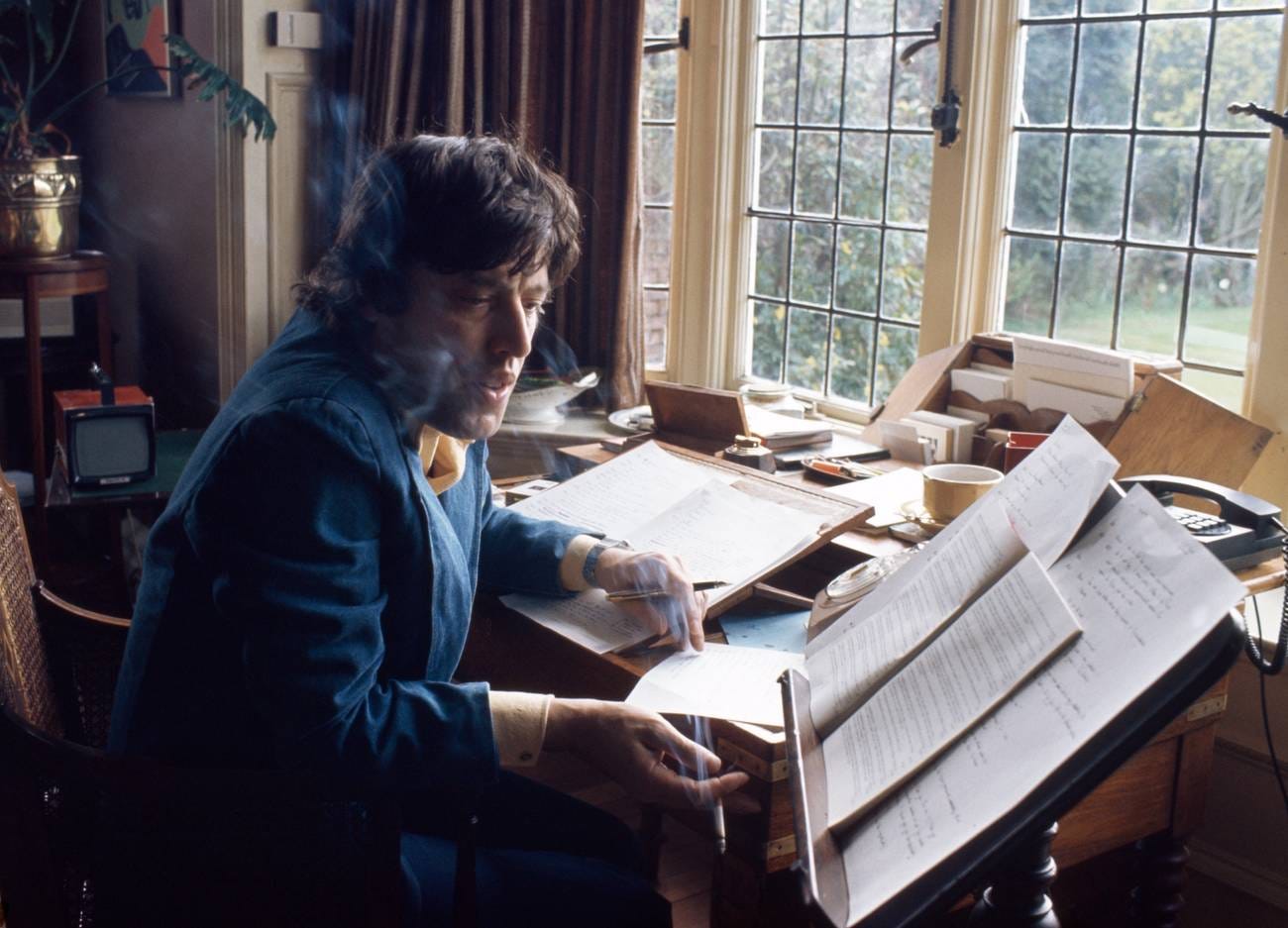
(Photo by Patrick Ward, Getty Images)
Modern literary biographies are largely about modern celebrity. Stoppard got famous at a time when playwrights and screenwriters could be as much press attention and money as mid-to-high-tier rock stars. He did this in the U.K., where television and radio had government mandates to spread “highbrow” culture. This was in decline when I lived in the U.K. (1998-2000), and comparable to what I was used to: Government-funded media channels funding educational and high-art programming, without a mandate for a “hit,” but with high enough quality that something (Bill Moyers with Joseph Campbell, Ken Burns getting George Plimpton to read Civil War letters home) clicks and bumps up against trash culture. Another lucky aspect of my timing: I was near London when “The Real Thing” was revived with Stephen Dillane and Jennifer Ehle in the leads, and I went to see it on a class trip. What did a 18-year old know about the themes of Stoppard’s relationship play? Nothing, but I could tell it was good; plus, I was one of those contrarians who felt like “Shakespeare in Love” deserved the Oscar. (Midcult people who watched the Oscars, like me, can still remember what Stoppard said once he won: “I’m reacting like Roberto Begnini underneath.”)
Lee’s biography has all the detail I could want about Stoppard’s Hollywood years; he was phenomenally successful at punch-ups and cutting when a producer was trying to put him in the wrong direction. Those stories make up maybe a tenth of the book, which is stirring in the early sections about the young Czech family’s flight to east Asia, his British education, and early journalism. Stoppard’s life is so varied and interesting that the celebrity sections stay entertaining, and the plays are so diverse in theme and ambition, that Lee can give the reader a little education through the research Stoppard did while not doting over his kids.
When I put this doorstop down I quickly read Luna frontman Dean Wareham’s memoir “Black Postcards,” another hardcover I’d taken from a remainder bin — a very efficient story, no fat whatsoever, just an intellectual rock musician’s memories from childhood to his band breaking up and him reading reviews about how they were just okay. It was easy to rip through Jason Zengerle’s Tucker Carlson biography “Hated by All the Right People” because I was alive and in the mix (in D.C.) for most of the narrative. If I’m skimming a book, I try to stop myself and read a passage again. The exception is if I am reading a paragraph with facts already known to me, which is true of lots of news stories, and true here; Zengerle boils down one incident I lived through over months into one page, which feels like what it deserves. The transformation of media relevance over Carlson’s career, and his ability to see what’s coming, is the most important theme of the story; the section about his MSNBC and PBS shows, the sort of sober, explanatory, smart commentary and journalism that people now miss, is less about Carlson than about MSNBC deciding it could get more ratings with yell-fests than with Carlson and Rachel Maddow informing the audience with witty conversations.
Griffin Dunne’s memoir was nice and lurid, channeling his father’s Dominick Dunne’s irritation at the other wing of the family — John Gregory Dunne and Joan Didion — and his satisfaction when the crime stories he wrote after his daughter’s murder became much more lucrative than JGD’s. (When he became less famous than his brother, JG Dunne wrote a nasty introduction to a piece that made fun of the families that attend trials and relive the horror of loved ones’ murders; the Dunne-Didions had chosen to stay in Europe instead of joining Dominick, Griffin et al in attending the trial of Dominique Dunne’s murderer, and nobody in the family forgot it.)
Just one novel. I’d bought Knut Hamsun’s “Hunger” a year or so ago, in one of those helpful manic moments when I decided I should read at least one book by every Nobel laureate. At that moment I knew nothing about Hamsun’s Nazi sympathies, and would have bought the book if I had; I don’t chase dead authors out of my library if they’ve done bad things. But I remembered the book after reading that Donald Trump’s demand that last year’s Nobel Peace Prize laureate hand him her medal put him in the company of one other person: Josef Goebbels, who accepted Hamsun’s prize. “Hunger” was a quick read, and I instantly saw what Bukowski liked in Hamsun, recognizing the effort to convey the emotions inside the mind of a frustrated man who’s trying to make virtues out of his bad habits and setbacks. It’s not about poverty, but my translation had interesting things to say about it: “I asked the prices merely so I could come as near them as possible.”
Books read
Hermione Lee, “Tom Stoppard: A Life”
Dean Wareham, “Black Postcards”
Griffin Dunne, “The Friday Afternoon Club”
Jason Zengerle, “Hated by All the Right People”
Knut Hamsun, “Hunger”
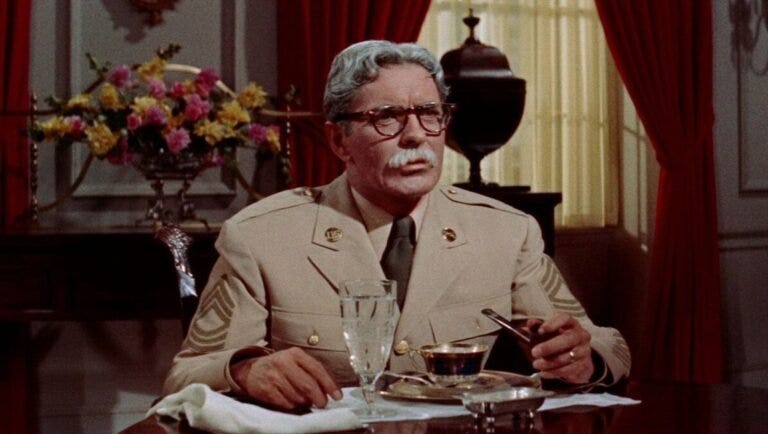
The Best Thing I Watched: “The Long Gray Line,” a sentimental 1955 John Ford film about a naive Irish immigrant who becomes a beloved West Point instructor. “Sentimental” understates things a bit. Tyrone Power plays Marty Maher, who walks off a train with his belongings and joins the military academy as a cook. (He is preposterously naive about what the Army is, with a surprise that would make more sense for a North Sentinelese native than a man from still-imperial Ireland.) Over a long life, he befriends the future heroes of World War II, falls in love, and fills their tragically empty nest with earnest, wise-cracking cadets who treat him like a father.
It’s a formulaic movie, with a wraparound structure reminiscent from “Yankee Doodle Dandy” (Marty meeting with his old cadet, President Eisenhower) and a familiar plot about a teacher living through his students. But I’ve been enjoying the sincerity of John Ford’s movies, with their morally rooted heroes who stiffen their backs and push ahead through personal disasters. All that and a joke about young Ike fretting about hair loss.
I’ve been choosy about what I watch. If it’s on the big screen where the kid could see it, I stay away from violence or profanity; not that she can hear it, but who knows what they retain from the buzz of noise and images. If I relaxed on my own I could watch heads blow up. Under those conditions I had a great time with “Heroes Shed No Tears,” a John Woo cheapo about Chinese mercenaries battling a Thai drug lord in the bush. These aren’t flashy Woo heroes who can jump sideways in slow motion while emptying their clips. Both forces are desperate, sweaty, and violent, filling bodies with bullets, launching sneak attacks, counting their dead. My wife put on “The King,” the goofball Netflix “Henry V” adaptation that probably got Timotheé Chalamet cast in "Dune,” and I finished “The Bad Sleep Well,” Akira Kurosawa’s other corporate potboiler, which has a better first act than “High and Low” but a deflated third act.
I did go down an SCTV hole, too, after Catherine O’Hara died. SCTV played the role in my parents’ home that the Las Ofrendas play in some Oaxacan grandmother’s home; we worshipped it.
The Best Thing I Heard. Not much new music this week, but I discovered that “Live from Daryl’s House,” a boomer babysitting show in which Daryl Hall’s friends record music and make banter at his home studio in Dutchess County, did a Robert Fripp episode. Big news for someone who has tried to convert dozens of people to “Sacred Songs” and “Exposure.”
Love John woo, as an appreciatior of JCVD hard target is probably his best. Didn't know that about goebbels, good piece of trivia