Russian winter
In which I remember how to read


(A street, by me.)
It’s not good to spend this much time inside. Said it before: The big freeze of 2026 was conveniently timed for my family, which was always going to be at home, shepherding our baby from the Crying Every Couple Of Hours stage to a new stage — sometimes hard to imagine — when she will not cry every couple of hours. Beautiful world out there, but hard to roll over in a stroller. Some of the snow will melt this week, hopefully enough to reveal the flat, man-made surface under all this dangerous weather.
The animals, with fewer indoor alternatives, are enjoying the scene. On Saturday, walking the baby around the house, I went to a back door to open it and walk into fresh air. We heard a quiet clip-clop and saw three adult deer, two males and one female, walking into the yard, over the hard snow. They stopped and turned their heads, looking directly at the place where a door had just creaked and revealed a man in a bathrobe and a much better-dressed baby. I closed the door and let the deer have their run of the place. Have you seen a pile of deer shit on perfect white snow? I have. I decided that the above, slightly ugly picture from the one long walk I took all week is more pleasant to look at.
Not complaining, though — I’m not even commuting in this stuff. We spent quality time with the kid, changing diapers at a pace that made me weep for my ancestors and the round-the-clock washing of cloth diapers. The modern disposable diaper, with its lines that change color at the arrival of piss or shit, is a treasure. Especially for those of us with a poor sense of smell, which in other, important ways is a big asset for baby-rearing.
I’ve thought, too, about how I am using the time with the kid. Most advice from experienced parents for new parents boils down to “savor every moment, you’ll never get it back.” It’s quite easy to imagine my kid as a teenager who doesn’t want to listen to her parents, and easy to imagine how I’ll think about that: “Aw, dang.” Very soon, I’ll be in an airport, cursing a mechanical failure delay, thinking about the time I am missing with my kid. But I can miss that time right now, while in the house, by ignoring her to read or watch something.
One compromise, which I think I discussed before, is reading out whatever’s in front of me when the kid is awake. Right now, she doesn’t understand any words; we are not yet at the point when Frog and Toad Are Friends might stick with her but Crime and Punishment will be a stream of confusing sounds. That’s my cue.
The Best Thing I Read. Crime and Punishment, conquered after reading it in chunks over eight months. That’s not the way to do it. “To read a novel requires a certain amount of concentration, focus, devotion to the reading,” Philip Roth once told Tina Brown. “If you read a novel in more than two weeks, you don’t read the novel, really.”
It took me a long time to process that. At the root of all my bad habits: A desire to make a good feeling last longer. Beer from a foreign trip, bought to give to friends at a party, went un-drank and got spoiled because I couldn’t find the perfect moment to give it away. Same with wine; I spent 15 sad minutes with a friend who actually understood wine, and had come to my house to drink some, as she went through my collection and identified the cheap stuff that wouldn’t actually age well. It should have been drunk by somebody who’d have appreciated it.
Same with books. Picking one up isn’t a problem. Committing to it, amid all the competition for my attention — that’s the problem. It’s never been hard for me to absorb five minutes of information, then switch to another task, then absorb five minutes of information from another source. Not a bad habit for reporting, actually; you know when you need to research and read deeply, and you know when you need to zoom around the bases to hit deadline. Non-fiction wasn’t hard to take in hour-long chunks, and I could’ve (but didn’t) scoff at people who found The Power Broker or Nixonland hard to consume. Each time I went into the book, I stacked more information. Easy as.
Only in the last year have I regained my teenage ability to power through long novels. Crime and Punishment benefits from close attention; there are many stories now that draw you inside the mind of a sick, pathetic man, but I doubt many were written by people who didn’t spend days living inside Rodion Raskolnikov. “Existence alone had never been enough for him; he had always wanted more. Perhaps it was only from the force of his desires that he had regarded himself as a man to whom more was permitted than to others.” The closest thing I have to a complaint: You learn this lesson again and again, which powerfully evokes the recursive mind of the guilty man.
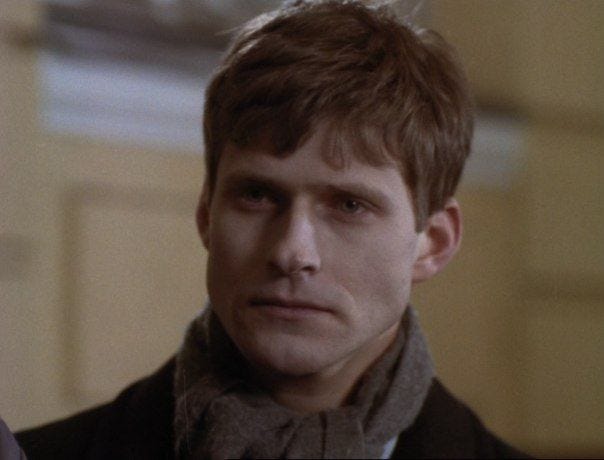
(Screenshot from the Russian C+P adaptation that stars… Crispin Glover?)
I listened to one audiobook when my hands were busy: Entrances and Exits, the Michael Richards memoir released in 2024. The short story of Richards’s life is that a middlingly successful comic actor struck gold on “Seinfeld,” couldn’t figure out what to do next, and imploded his career by blowing up at a black Laugh Factory heckler and calling him a racial slur five times.
That took place nearly 20 years ago, when comedians could still be shocked that someone held up a camera to surreptitiously film their act, and that it would be easy for people to find the videos. Richards didn’t just screw up; he screwed up in a historically important way. Last year, when “Smiling Friends” ran a joke montage to sum up the career of Mr. Frog — a murderous, godlike celebrity who becomes emperor of Earth — it included a shot instantly recognizable as Richards melting down at the Laugh Factory.
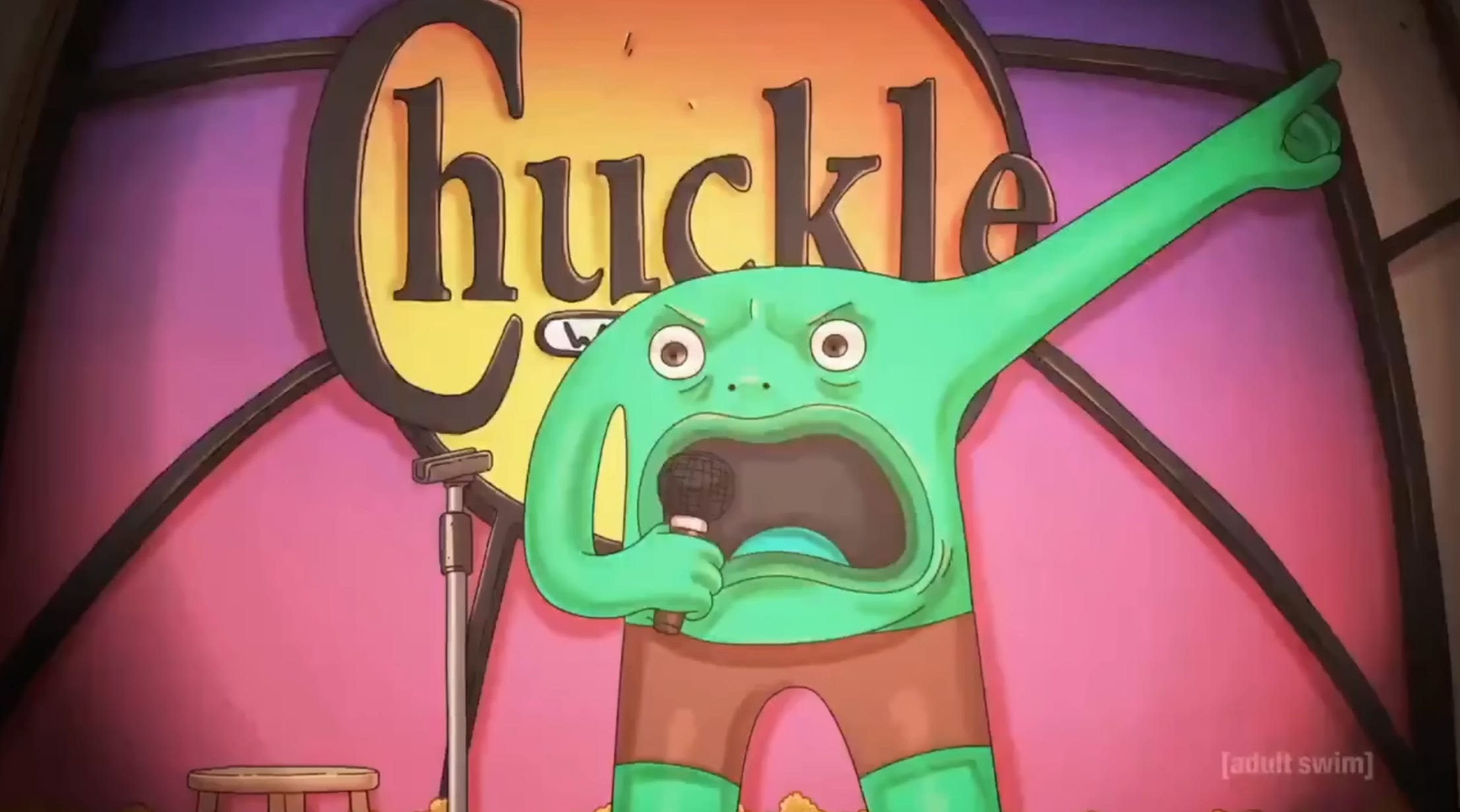
(Screenshot from “Smiling Friends”)
Richards started writing his memoir a decade later, and he can’t even bring himself to write down what he said — onstage or in the clean-up attempt he made on “The Tonight Show.” He’s had six acting roles since the incident; three of them, the only ones people saw, were reunions with Jerry Seinfeld.
Entrances and Exits finds a basically retired actor who regrets not having one more turn — specifically, turning down “Monk,” which would have given him a second iconic character and years of steady work — but is otherwise happy with his life. He grows up odd, smart, and decent, but unsure what to do after leaving the Vietnam-era Army; he reads a lot of philosophy and great books and has an unsatisfying marriage. The memoir is most interesting for the look inside one of the most successful sitcoms of all time, from contract negotiations (Richards asks for $1 million per episode after Seinfeld tells him “the money’s there”) to bitterness at missing out (Richards furious that he has no scenes in “Chinese Restaurant”) to the emotional rush of winning an Emmy he thought was going to a co-worker. Richards does pull back from total revelation, protecting his reputation and emphasizing how much of his new money went to buying old books and new bookshelves.
Focusing on just one book this week: War and Peace. Amazon’s record says I bought the Pevear and Volokhonsky translation in February 2011; I think for a minute but can’t remember why, when I was signing up for coverage of the Tea Party Congress that would absorb half my nights and weekends, I thought “I’ll read War and Peace.” I started it and gave up before the end of the first book, and started it again a few years later, quitting it when I saw my finger click to a new page and realized I had just been skimming. I’m now reading one part a day, at least, to finish it with some time left; I’m interrupting it for chores and writing a back-to-work memo. The battle scenes of Book One, Parts II and III, and Pierre’s naive attempts to become a good man through becoming a freemason and taking their dogma much too seriously — already some of the best stuff I’ve read in years.
Books read
Jacqueline Harpman, I Who Have Never Known Men
Fyodor Dostoevsky, Crime and Punishment
Michael Richards, Entrances and Exits
The Best Thing I Heard. Still much too eager to discuss my project of listening to every Marc Maron podcast. It’s a parody of a way someone my age would waste time; if the person I’m telling wants to keep talking to me, our friendship has passed its hardest test. This week, stir crazy and thinking through where a new shelf would fit in my basement library, I decided to stop skipping around episodes of “WTF,” and listen through every unheard episode in chronological order, picking up in June 2011.
When I’m done with this — maybe in 2027? — I’ll have more thoughts about what I learned. The most obvious lesson comes early, when Maron and his comic friends say the sorts of words they would stop using in Barack Obama’s second term. They end jokes with “retard” and “tranny,” winking at the transgression — mitigated by them being right-thinking liberals. By 2012, a guest gently admonishes himself for using the R-word at a Live WTF taping; by 2014, Lena Dunham is telling him about the queer colleagues who have explained why “tranny” doesn’t get thrown around for fun. In the Trump years, I know these comedians will recant their old language, and that rival comedians who recoil at this “woke” attitude will gain millions of listeners and fans, by being as jocular about race and sex and intelligence as everybody was in the early 2010s. It’s interesting to hear this evolution happen slowly, episode by episode.
A more specific point about this podcast, especially when you listen to it no matter who the guest is: You can bet on certain interviews being more fun than others. A rough ranking I’ve made after a few hundred hours.
The old journeyman comic. Maron lights up when he’s talking to some comedian who peaked in the 1980s and never had a second act, whether they’re still on the road (a residency at Hooter’s casino!) or whether they washed out and went to rehab. He has an immigrant’s zeal for the stand-up stage, and wants to respect what these men (usually men) did; he bonds with them over fucking up and not seizing the opportunities that better-adjusted comedians took.
The peer who Marc has a history or a beef with. Early conversations with people who went another way in the stand-up schism (Adam Carolla, Joe Rogan, Bill Maher) are fascinating, especially Carolla’s reflections on growing up poor and neglected; his refusal to go along with more privileged comics and put up with welfare liberalism made a lot more sense after the episode was over.
The comedy legend. Maron’s love for craft shows up here, but — personal preference — I pick up more from the conversations with nearly-was stars.
The director Marc’s a big fan of. Maron’s early self-sabotage of his acting career (betting it all on Yale Drama and not getting in, getting high before his SNL audition) comes up in his movie conversations, but they’re more helpful when he’s trying to figure out directors than fellow actors.
The rising star who hasn’t been asked about this stuff. Very fun (to me) to find these moments when Aziz Ansari explains why his early stuff sounded so much like Mitch Hedberg, or when Bob Odenkirk says he’s agreed to play a sleazy attorney on some new sitcom. More fun when they take an hour to detail their lives and neuroses.
Any musician. I find it endearing when Maron reminisces with Kim Deal or whoever about the scene they came up in, and he’s a passionate amateur guitarist who went further than I ever will in trying to understand how rock music worked. But these are the interviews that get him star-struck.
The comic artist Marc’s a big fan of. My bias here, as a longtime comics fan who’s aged out of it: Comics writers and artists don’t do as many interviews as their peers in film or music; their work is more solitary; their world (of publishers etc) is smaller. Not terrible interviews, just not as much to work with.
The Best Thing I Watched. My friend Mike, one of the few millennials I know who’ll call before texting (not a bad thing at all), sometimes rings me to describe something he found on the Criterion Channel. Mike, who splits his time between Pittsburgh and Rio — guess where he is now — is particularly good at finding stories of ordinary people living under fascism. That took him to “Una giornata particolare (A Special Day),” a study of an erudite gay man (Marcello Mastroianni) and an exhausted, semi-literate mother (Sophia Loren) who bond on the day that Hitler visits Mussolini’s Rome. Mastroianni is shockingly convincing as a gay man who doesn’t want to make out with Sophia Loren, grim with he’s paging through her Mussolini scrapbook; Loren is convincing as the middle-aged woman who wants to believe that the rulers are doing the right thing, and feels something wrong when her neighbors agree with her. (“So what if a man’s a scoundrel? What matters is that he’s faithful to the party.”)
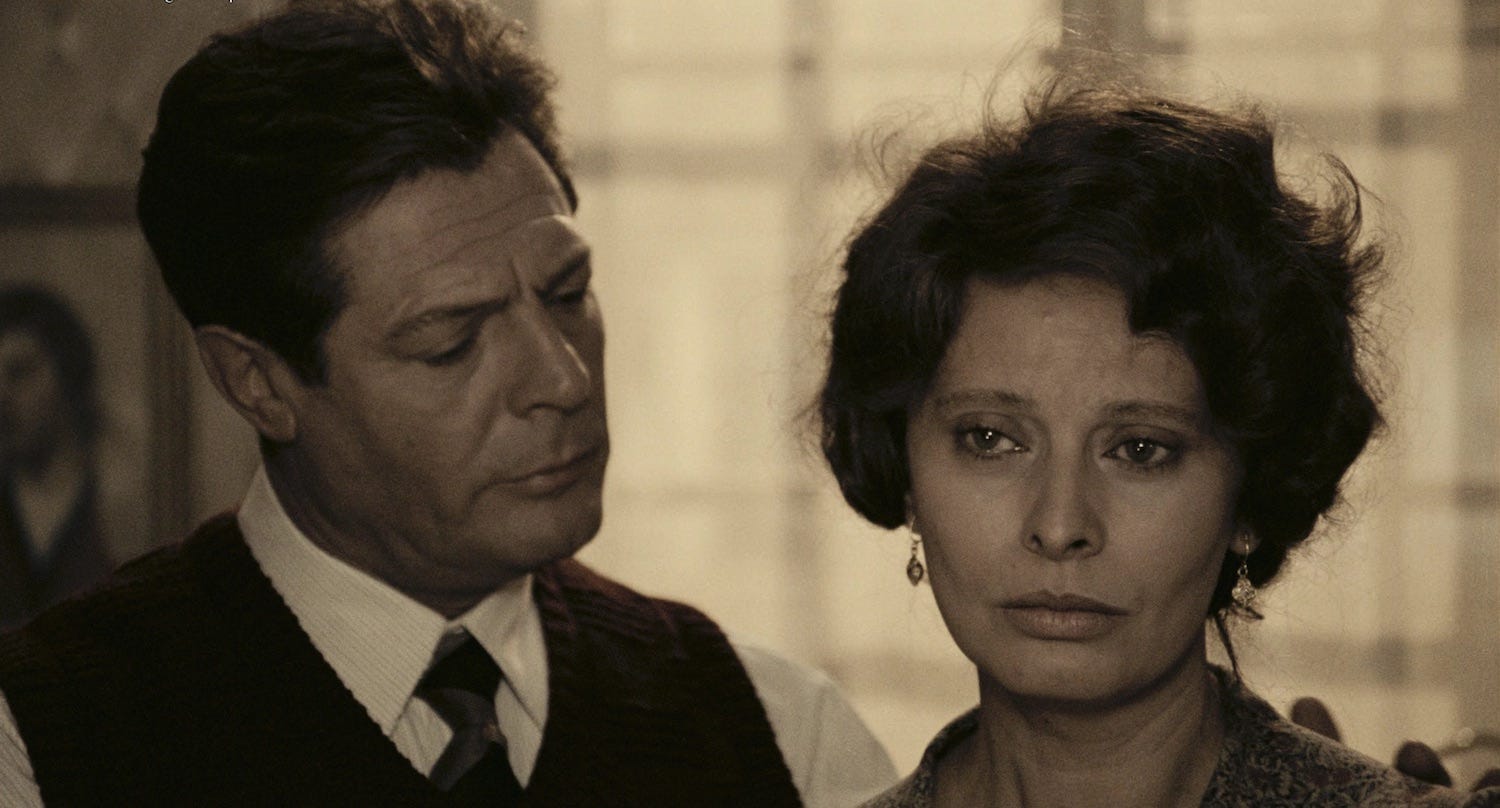
Not much onscreen apart from that. The TV’s on Olympics duty for the next couple of weeks, and I’ve been enjoying my old favorites when I need a break from Tolstoy.
Back later.
This is wonderful
Is your real name… Stacey?